.png)

Otero County Seeks D3 Extreme Drought Designation as Agriculture and Water Supplies Face Severe Strain
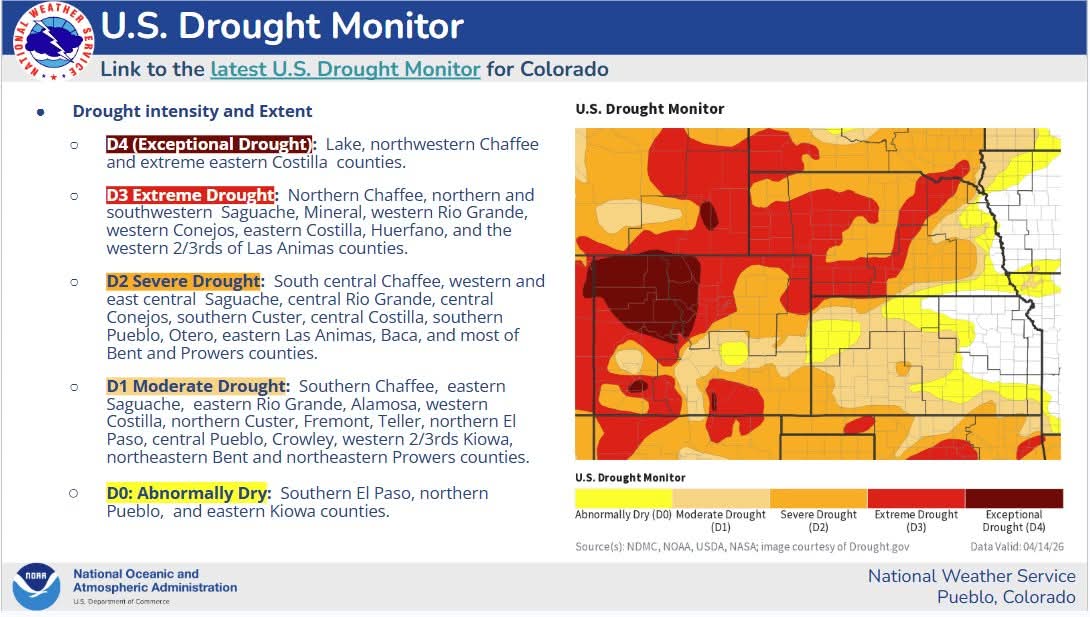
Description: Otero County urges D3 extreme drought status as worsening conditions impact agriculture, water supply, and local economy in southeastern Colorado. Read the full Letter...
Support for D3 (Extreme Drought) Designation - Otero County
April 13, 2026
Dr. Russ Schumacher
Colorado State Climatologist
Colorado Climate Center
Department of Atmospheric Science
Colorado State University
1371 Campus Delivery
Fort Collins, CO 80523
Dear Dr. Schumacher:
On behalf of Otero County, the Otero County Board of County Commissioners respectfully submits this letter in support of designating Otero County under a D3 (Extreme Drought) classification.
Otero County continues to experience prolonged and increasingly severe drought conditions resulting in significant impacts to agriculture, water resources, livestock operations, municipal supplies, and the overall local economy. Below-average precipitation and persistently elevated temperatures have increased evaporative demand and stressed surface and groundwater systems throughout the county, while historically low upstream snowpack and early-season warmth have reduced runoff and limited irrigation supplies as the growing season begins. Local observations and sector-specific impacts provide critical context for drought classification, particularly in agriculturally dependent regions that rely heavily on groundwater and irrigation supplies, such as Otero County.
Local agricultural producers are reporting concerns regarding crop losses, reduced forage availability, and escalating input and hauling costs. Many livestock operators have indicated that continued drought conditions and limited pasture productivity may force future herd reductions if conditions do not improve. Irrigation-dependent producers are encountering constrained water supplies at the outset of the irrigation season and uncertainty regarding allocations and well reliability, placing current yields and long-term operational viability at increased risk. Agriculture is a cornerstone of Otero County's economy and community, and continued drought conditions pose disproportionate risks to local producers, employment, and overall economic stability. In Otero County, drought impacts to agriculture, water systems, and community stability are closely interconnected and droughts of this magnitude can be particularly disruptive for regions like Otero County, where agricultural production and water availability are closely linked, and recovery can extend well beyond a single season if conditions persist.
Municipal and rural domestic water systems within Otero County are under increasing strain due to limited recharge, elevated demand, and continued dry conditions, with growing concerns regarding the sustainability of groundwater supplies and available storage. The continued absence of meaningful precipitation poses serious risks to essential public services, long-term water security, and economic stability throughout the region. Otero County's reliance on groundwater and limited storage capacity increases vulnerability during extended dry periods and amplifies the impacts of elevated temperatures and reduced recharge.
Based on verified local observations, documented economic impacts, and measurable hydrologic decline, Otero County strongly supports recognition of D3 (Extreme Drought) conditions. Accurate classification is essential to ensuring proportional situational awareness, coordinated planning, and timely response across state and federal partners, and to supporting access to available preparedness, mitigation, and assistance resources. This designation is critical to accurately reflecting on-the-ground conditions affecting southeastern Colorado.
Otero County appreciates your continued leadership and collaboration in monitoring and evaluating drought conditions across Colorado. We respectfully request that these documented local conditions be given full consideration in upcoming drought assessments and classification updates affecting southeastern Colorado.
Please do not hesitate to contact our office should additional documentation, local data, or testimony be helpful.
Sincerely,
Rob Oquist,
Chair Tim Knabenshue
Jim Baldwin