.png)

Larimer County Mountain Lion Investigation Update: CPW Ends Search and Releases Findings
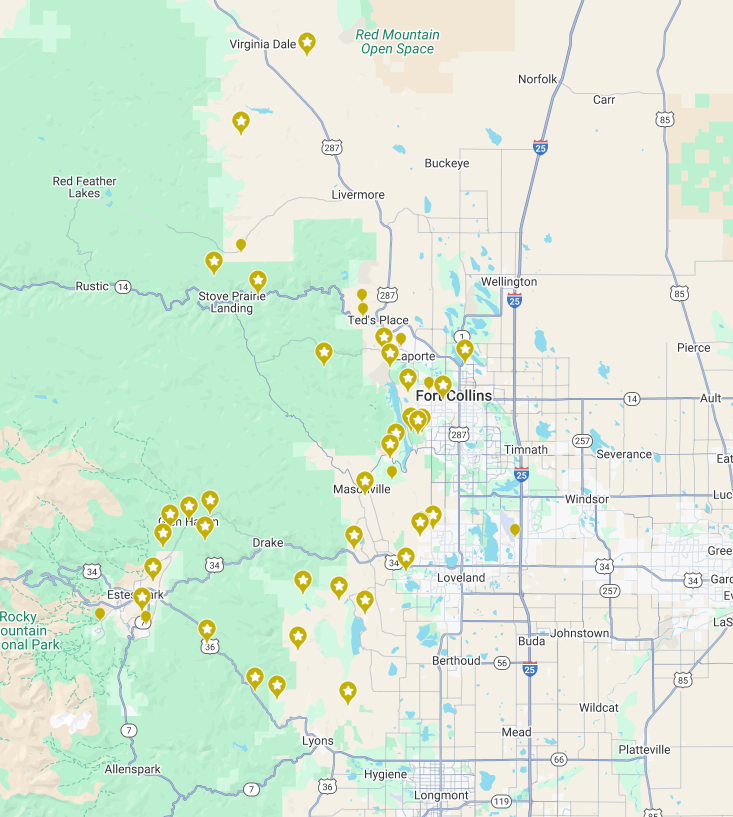
Description: Map of mountain lion sightings, conflicts, and reports to CPW for Larimer County 2025... Colorado Parks and Wildlife has concluded its investigation into a fatal mountain lion attack on Crosier Mountain Trail in Larimer County, reopening the trail and releasing updated findings and safety guidance. Read the Full Statement from Colorado Parks and Wildlife...
Colorado Parks and Wildlife update on Larimer County mountain lion investigation
DENVER – Colorado Parks and Wildlife has ended the active search for a third mountain lion in the area of the fatal attack on a woman on the Crosier Mountain Trail in Larimer County. CPW officers, federal agency staff and houndsmen with trained dogs searched thoroughly for more than 72 hours. No fresh tracks or scents were detected. Crosier Mountain Trail is back open to the public, and mountain lion signage with education messages will remain. Permanent signage warning of lion activity and how to handle conflicts has been in place on the trail for years.
Any mountain lion sightings or conflicts should immediately be reported to CPW by contacting either the Denver office at 303-291-7227, the Fort Collins office at 970-472-4300 or Colorado State Patrol at *CSP (*277) to reach an on-call officer. Crosier Mountain Trail lies in mountain lion habitat. Residents and visitors should continue to remain vigilant.
“Our hearts go out to the victim’s family,” said Mark Leslie, Regional Manager for CPW’s Northeast Region. “This is a terrible tragedy. This hiker did what many people did on New Year’s Day. She went out in nature on the first day of a new year, and the fact that she did not return to her family and friends is nothing short of heartbreaking. We encourage the public to have compassion and empathy for her and her loved ones.”
CPW thanks the agencies who assisted in the initial response and search: Larimer County Sheriff’s Office, Estes Park Police Department, Larimer County Parks and Open Space, Glen Haven Area Volunteer Fire Department and U.S. Department of Agriculture Wildlife Services.
Necropsy results:
Necropsies were performed by CPW pathologists on two mountain lions. Initial results indicate a family group consisting of one approximately 12-month old male subadult lion and one approximately 12-month old female subadult lion in very good body condition with no signs of organ abnormalities (subadult refers to lions older than kittens but not yet to breeding age, typically breeding age is 2.5 to 3 years). Human DNA was found on all four paws of the male subadult lion. No human DNA was detected on the female subadult. Both lions tested negative for rabies. The final necropsy report has not yet been completed.
On January 1, witnesses observed a mountain lion standing over the victim on the Crosier Mountain Trail. As they approached, they began throwing rocks to scare the lion from the area and attend to the woman. Witnesses also called 911. When officers arrived on scene, the male subadult lion approached the incident area, was shot by an officer and ran off. CPW officers on the ground and houndsmen tracked this lion and euthanized it, noting it had a wound from the earlier officer’s shot. The second lion, the female subadult, was seen in close vicinity to the site and was tracked and euthanized by CPW. Shortly after, a third lion was observed by officers approaching the incident area. This lion was also pursued by hounds but CPW officers were unable to locate it. Due to multiple lions present at the attack area and evidence found at the scene, CPW officers suspected a family group was responsible.
“It is very unlikely that these lions were in such close proximity to the scene by coincidence,” said Leslie. “This is not a decision we take lightly. CPW is charged with protecting human safety. Given the gravity of this situation and the rarity of this type of behavior, this was a necessary, if unfortunate action.”
Recent mountain lion activity in the Glen Haven area reported to CPW and subsequent management actions:
-
On 10/28/2025, a man was hiking with a dog off-leash in the 2000 block of McGraw Ranch Road in Estes Park. A mountain lion attacked and killed the dog. The incident was reported to CPW on 11/20/2025.
-
On 10/29/2025, a woman was hiking with her dog off-leash on West Creek Road in Larimer County. A mountain lion suddenly appeared and took her dog. The incident was reported to CPW on 10/30/2025. A CPW officer responded to the scene and was unable to locate any lions.
-
On 11/12/2025, a man was trail running on Crosier Mountain Trail and observed a lion in front of him in the trees. The lion approached the man but never made contact. The man successfully hazed the mountain lion with a tree branch and by throwing objects. The incident was reported to CPW on 11/12/2025. CPW officers responded to the area and were unable to locate any lions. Signs warning of increased mountain lion activity were placed in the area, in addition to the permanent mountain lion signage at the Crosier Mountain Trail. The temporary signs were removed after a few weeks.
-
On 11/30/2025, a man and woman were hiking near Crosier Mountain Trail summit when they encountered two mountain lions. One lion was spotted in front of them, another was spied behind the couple. They were able to successfully haze the lions by yelling and throwing rocks. No physical contact was made. The incident was reported by voicemail to CPW and received on 12/1/2025. CPW officers responded to the area and were unable to locate lions on the trail. A temporary sign warning of mountain lion activity in the area was placed at the trailhead, in addition to the permanent signage warning of mountain lion presence on the Croiser Mountain Trail. The temporary sign was in place on January 1.
-
On 12/23/2025, a man living off County Road 43 in Glen Haven found a mountain lion attacking his dog in his yard. He shot and killed the 3-year-old adult male lion. The incident was reported to CPW on 12/24/2025. A CPW officer responded, investigated and no citations were issued. A necropsy showed the adult male lion did not have any abnormalities. Due to its age, CPW biologists do not think it was a parent to either of the subadults.
-
No other mountain lion-related attacks or sightings have been reported to CPW in the Glen Haven area during this time period.
“Timeliness is critical for tracking and responding to mountain lion conflicts,” said Jason Duetsch, CPW Area Wildlife Manager. “We encourage anyone to immediately report encounters with lions so CPW officers can have the most effective response.”
Mountain lion behavior and biology:
Larimer County has a high density of mountain lions due to its deer and elk populations and healthy habitat. Male and female mountain lions could mate at any time of year. They are usually together for a few days or up to a week then separate. The female lion will raise one to four kittens, and kittens can be born year-round. Subadult lions appear adult-sized and will stay with their mother until they are up to 18 months of age. This is why it is not uncommon to see multiple lions together. After leaving their mother, male subadults will travel to find a new territory. Male lions will defend their territory from other adult or subadult male lions. They are known to tolerate female lions in their territory. Female subadults will often settle in the same territory as their mothers.
Mountain lions in Colorado mainly prey on deer and elk and are known to be solitary and reclusive. They are “spot and stalk” predators, often taking their prey by surprise by attacking at the neck, windpipe or skull from behind. Once lions take their prey, they will create a “cache” by covering the kill with sticks, rocks, leaves and branches to hide their meal. Lions will return to a cache over the course of several days to continue to feed. They may aggressively defend caches from any perceived threats or other predators.
“Although lions are generally solitary, it is common or typical to see family groups of a mother and offspring living and hunting together,” said CPW Mammals Researcher Mat Alldredge. “Offspring will stay with their mother for about a year-and-a-half while learning to hunt and become independent. They are generally dependent until 18 months old when they disperse in the spring from their mother’s home range.”
Living with mountain lions:
While it is not possible to remove all risk posed by mountain lions or other wildlife, there are ways to reduce the risk to people and pets. Lions can be active at any time of day or night, but they are most active dusk through dawn.
-
Be aware of your surroundings. Avoid wearing ear phones or other devices that limit your senses.
-
Recreate in groups keeping children between adults.
-
Keep dogs on leash. Do not let dogs outside, especially dusk through dawn, unsupervised. Use a bright light to check surroundings and make noise.
-
If you see a lion make a lot of noise, raise your arms to look big, back away slowly and do not run. Throw rocks or other objects at the lion.
-
Be prepared to fight back, a lion may be deterred if it perceives a threat.
-
Avoid attracting prey species such as deer or racoons to your yard, do not feed wildlife.
-
Remove thick bushes and low tree branches from your yard to limit cover and increase visibility.
Related Content:
CPW Investigating Suspected Fatal Mountain Lion Attack on Crosier Mountain Trail in Larimer County